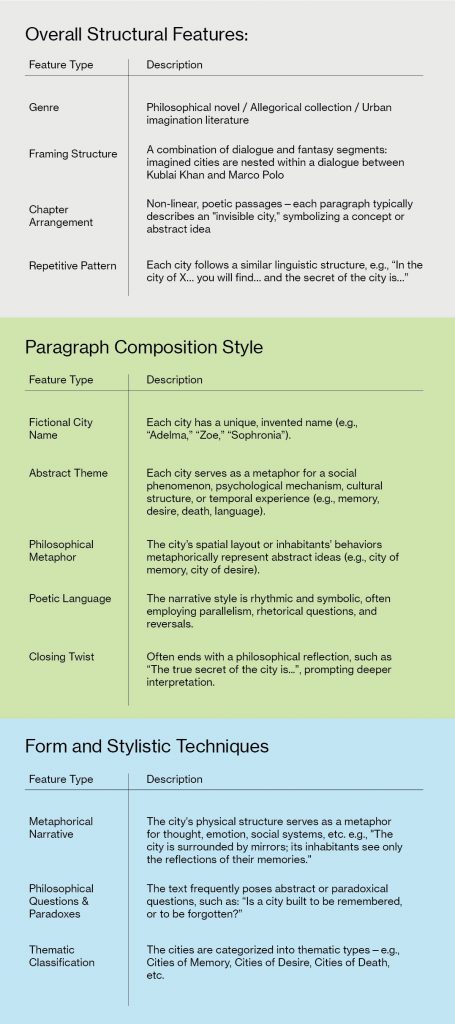
The text adopts the narrative form of the book Invisible Cities. Below is my analysis of its structural features.
(The following is a reimagining of Hito Steyerl’s In Defense of the Poor Image, rewritten in the style of Italo Calvino’s Invisible Cities.)
The traveler spoke of three cities—cities that do not appear on maps but live on the margins of the network. There, images are no longer postcards but ghosts of revolution; no longer prized for clarity, but existing within the folds of compression and circulation.
Rosetta, the City of Images:
In Rosetta, every building is made of screenshots and pixels. Compressed, re-uploaded, renamed. Faces flicker across the walls, looped clips form the roof tiles. Even the bricks are sheaths of magnetic tape from discarded VHS cassettes.Here, resolution is irrelevant. Citizens gather before low-res projections and ask: Whose hard drive did this file come from? Was it captured during a protest? When were these subtitles added? “This is not ruin,” an elder whispers. “It is a factory of memory.”In Rosetta, an image’s worth lies not in its definition, but in its journey—how it slipped out from museum vaults, survived years on torrent networks, dodged censorship, and returned to the gaze of the people.
Miladia, the City of Forgotten Things:
There are no cinemas in Miladia—only cemeteries of images. Here lie the films that never made it to screens: low-resolution ghosts buried in .mp4 files and cracked DVDs. These are rejected festival entries, vanished installations, unclassifiable video poems. Their formats are corrupted; their narratives fragmented—like sentences cut off mid-thought. But in Miladia, everyone is both mourner and alchemist. Citizens decode, subtitle, re-edit, and re-upload. Each pixel reborn becomes a small act of resurrection. A local legend claims: only the image compressed five times or more can glimpse true vision.
Zetica, the Networked City:
In Zetica, images spread like viruses. They belong to no one and answer to no authority. Streets are peer-to-peer links, rooftops host encrypted forums, the public squares are anonymous cloud drives. There is no copyright, no authorship. Files are dismantled, reassembled, forwarded again. In the hands of the masses, images mutate—reconstructed by software, recoded by strangers. “This is a visual commons,” a young man explains. “Here, we build communities from pixels unowned by capital.”
In Zetica, what matters is not whether an image is true, but where it came from—and who will pass it on.
In these cities, images no longer serve power. They are not bound to screens, archives, or state institutions. They wander—low-res, anonymous, ever reinterpreted. (Words: 378)