In Imagined Communities, Benedict Anderson argues that nationalism is not a natural entity but a socially constructed “imagined community.” This central idea runs through the entire book. Out of that process, Benedict Anderson argues, have emerged those ‘imagined communities’ we now call ‘nations,’ impersonal aggregations of strangers, dispersed in far-flung settlements, joined together in mutual awareness and common citizenship thanks to their shared activity as a reading public.
( Anderson, 2006, pp. 15-17 )
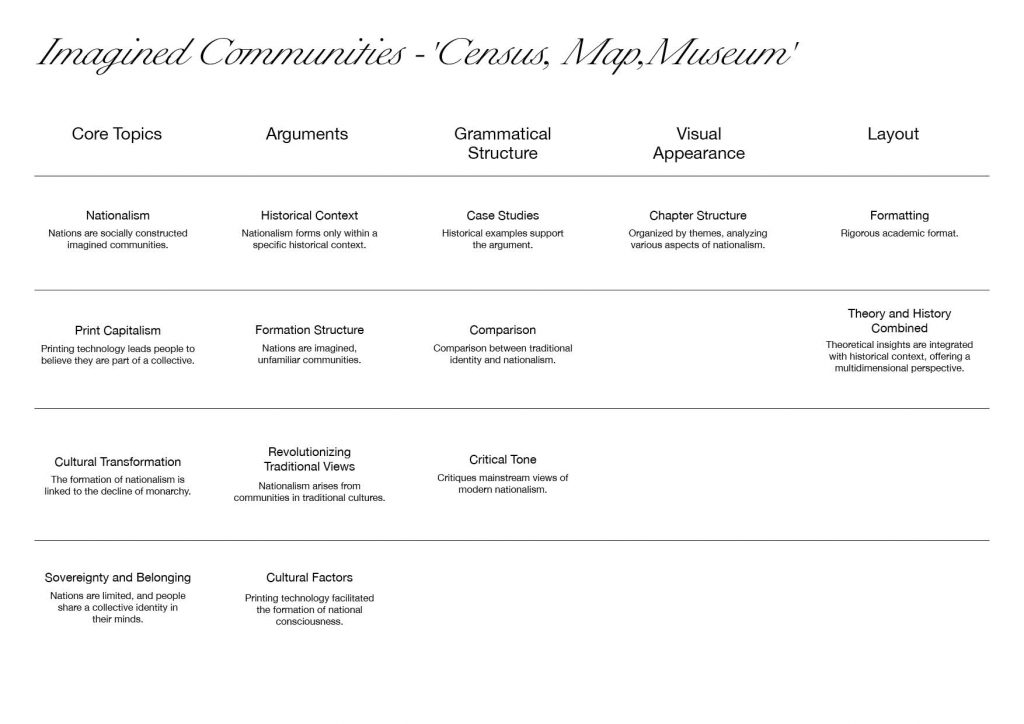
First, Anderson emphasizes that nationalism is an imagined community, where people, although they may never meet most of their fellow members, still share a common identity. Print capitalism plays a key role in this process. With the spread of printing technology, people were able to imagine themselves as part of a larger group through reading the same books, newspapers, and magazines. This made it possible for a collective identity to form across geographic and time boundaries. Moreover, the rise of nationalism is closely related to cultural change, especially the decline of monarchy and religious communities. Anderson argues that as these traditional structures faded, nationalism emerged as a new form of identity, replacing older ways of identifying oneself. In terms of sovereignty and belonging, Anderson points out that even though individuals may never meet all the members of their nation, they still share a collective identity, seeing their nation as a limited and sovereign community.
Next, in the arguments, Anderson explains that nationalism only emerges under specific historical conditions, especially with the rise of print capitalism and modern communication technologies. He argues that nations are imagined communities, which contrasts with traditional religious and monarchical identities. The development of print technology strengthened national consciousness, allowing people to feel connected to others in their nation, even if they did not know them personally.
Anderson’s grammatical structure supports his argument through the use of case studies and comparative analysis. He uses historical examples, especially the rise of print technology and capitalism, to back up his theory. He also compares traditional identities with nationalism, showing how nationalism has replaced or merged with old identity structures. Furthermore, Anderson uses a critical tone throughout the book to challenge traditional views of nationalism, offering a more complex and in-depth explanation.
Regarding visual appearance, Anderson’s book is divided into chapters that focus on different aspects of nationalism. This organization helps readers understand the various dimensions of nationalism. The formatting is structured and academic, with clear divisions between theory and historical context, giving readers a comprehensive understanding of nationalism.
By analyzing the table content, Anderson’s Imagined Communities not only explains the origins and cultural roots of nationalism but also uses historical examples and critical thinking to make the formation and spread of nationalism clearer.
(Words: 444)
Reference list:
Anderson,B. (2006) ‘Census, Map, Museum’, Imagined Communities. Maple Press
Leave a Reply