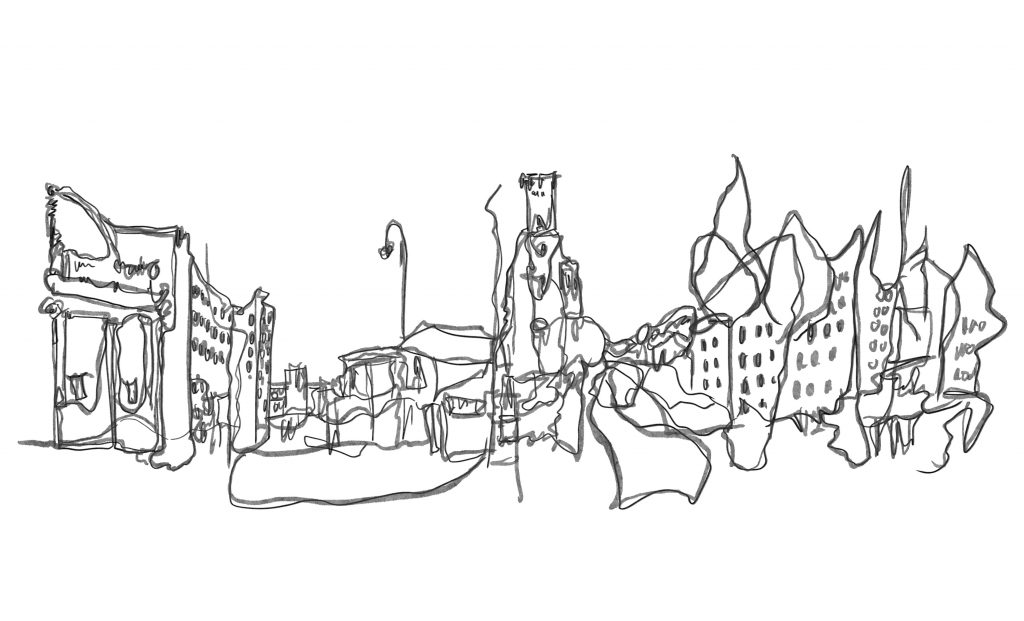
Benches are common elements in society. They not only serve as physical spaces for rest but also carry the interactions between individuals and society. Robert Venturi and other authors believe that modern architecture can achieve the “communication through space” function. They argue that space is not just an independent physical entity, it is also a medium for social behavior, playing a role in conveying social interactions and communication. (Venturi, Brown and Izanour, 1972, pp.8-9) This idea inspired me to explore the role of benches in public spaces. I began to think about how benches facilitate the interaction between the people sitting on them and the surrounding social environment.
In this process, the methods of observation played an important role in driving my research forward. Georges emphasizes the importance of observing the details of daily life, urging people to slow down and notice seemingly ordinary aspects of life that hold deeper meaning. (1974, p. 50) I chose to use sketching as a method to record the leg positions, hand movements, and head orientations of people sitting on park benches. Through these observations, I tried to capture the small actions of people in this public space. However, I gradually realized that relying on this rational observation method could not fully reveal the complex relationships between people and social interaction. I critically believe that traditional observation methods, while lack a deep understanding of individual emotions and social interactions.
Therefore, I decided to interview the people sitting on the benches to learn more about their feelings and perceptions of this public space. I also used illustrations to record their thoughts and emotions.Through these conversations, I discovered that park bench users express a rich range of emotions toward the space. They interact with the space in multiple ways. These delicate emotional expressions and behavioral reactions gave me a new perspective, helping me better understand the emotional needs and spatial perceptions of each individual in the space of bench.
By observing and illustrating these interactions, I was able to not only demonstrate the physical function of park benches as a space but also reflect on their social function in public spaces. The park bench is no longer just a simple resting place, it is a link for communication between people and space, and between people and society. It carries different social behaviors, cultural identities, and emotional expressions, becoming a bridge connecting individuals to the social environment. This provides new ideas for public space design: the design of park benches and other space elements should not just focus on providing a place to rest, but also consider how to promote social interaction and emotional communication through spatial layout and design.
In conclusion, park benches in public spaces are far more than just physical places for rest; they are carriers of social interaction. Through detailed observation and illustration, we can gain a deeper understanding of the role space plays in facilitating interaction between people and society. (Words: 486)
Reference List:
Perec, G. (1974) Species of Spaces and Other Places. Penguin
Venturi, R., Brown, D. and Izanour, S. (1972) Learning form Las Vegas. The MIT Press
Leave a Reply